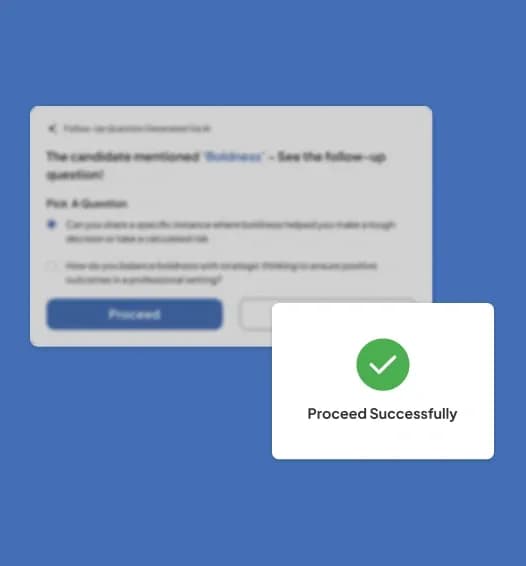
The candidate is mid-sentence. On the interviewer's screen, a card appears. No one hears it arrive.
AI that assists the interviewer.
Never runs it alone.
The S9 AI Interview Assistant standardizes questions, generates intelligent follow-ups, and flags bias-prevention cues in real time while the interviewer stays in control of every question asked. Built to support judgment, not replace it.
Silent to the candidate. Visible to the interviewer. That's the whole design.
What the assistant actually does, live
A skeptical reader should be able to see the mechanism here, not just take a claim on faith.
Pulls from the locked structure.Never improvises one.
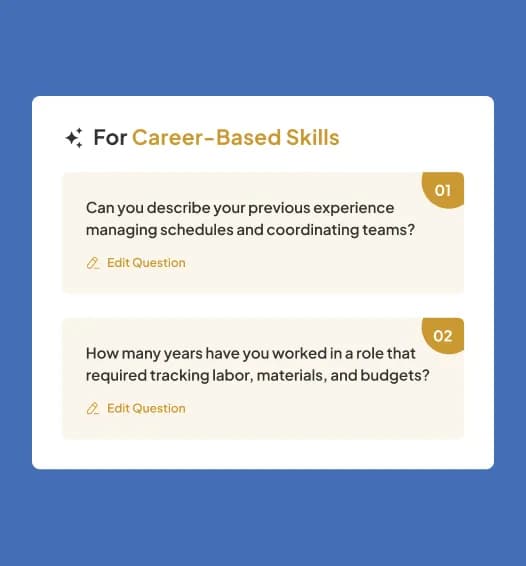
The assistant pulls directly from the Career, Role, and Culture skill set finalized in the Structured Interview Builder for this role it isn't generating questions from scratch or improvising a new structure per candidate.
Prompts the same way, every time.Never leaves it to memory.
Every candidate interviewing for the same role starts from the same standardized questions. Consistency isn't left to how well any one interviewer remembers the last conversation.
Follows up in the moment.Never recites a fixed script.
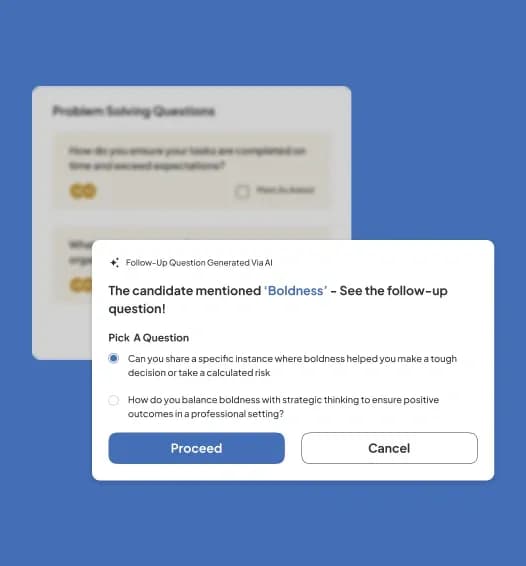
The S9 AI Interview Assistant generates follow-up questions based on what the candidate just said using proven interviewing techniques designed to surface honest, specific signal instead of rehearsed answers.
Stays on screen.Never off the record.
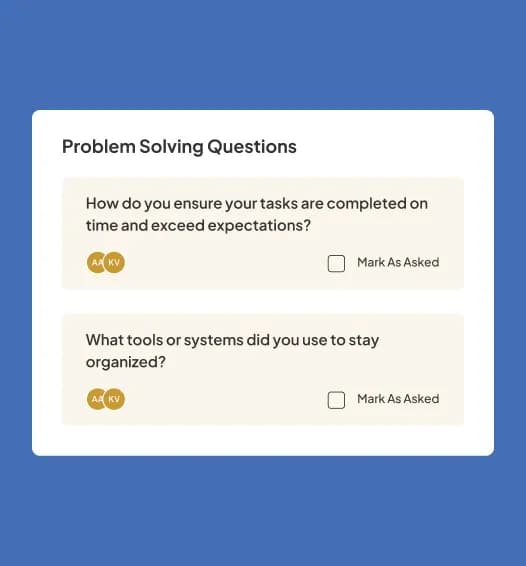
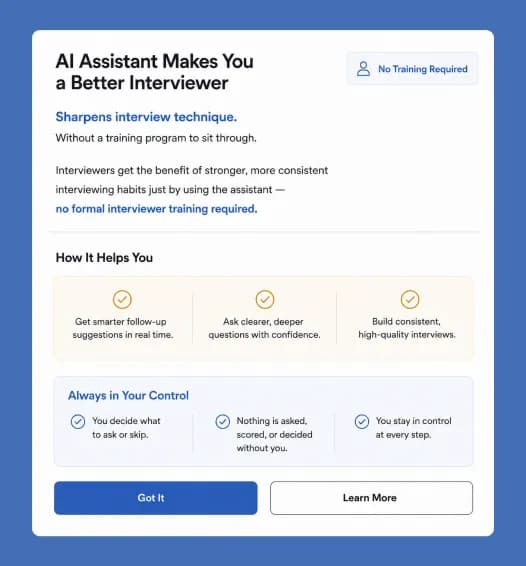
Every suggestion appears for the interviewer to accept or skip. Nothing is asked, scored, or decided without the interviewer actively there and participating.
Sharpens interview technique.Without a training program to sit through.
Interviewers get the benefit of stronger, more consistent interviewing habits just by using the assistant no formal interviewer training required first.
What makes its questions different
Most AI interview tools rely on generic behavioral prompts “Tell me about a time you handled conflict.” Candidates prepare for these in advance. Rehearsed questions get rehearsed answers.
The S9 AI Interview Assistant draws on proven interview methodologies used by professional interviewers to uncover the truth, not just a rehearsed answer. Rather than asking directly, it often surfaces a statement–something for the candidate to confirm, correct, or push back on. The reaction tends to say more than a scripted answer would.
Every prompt is calibrated to stay believable. A statement that’s obviously wrong gets either dismissed or corrected, letting a natural correction reveal insight instead of an obvious question trap.
“How do you use data in your marketing decisions?”
“Some marketers rely mostly on intuition, others mostly on analytics.”
No question mark. Just a statement, sitting there, waiting to see where the candidate lands and why.
“How long did it take you to get comfortable with our systems?”
“Most people get comfortable with a new system like this within a couple of weeks.”
The cue card, not the microphone
The S9 AI Interview Assistant never has a voice in the room. What it has is a card visible only to the interviewer, updating as the conversation moves.
Each suggested question or follow-up appears the moment it’s generated.
Any bias-prevention cue that comes up shows up right alongside it.
The interviewer decides, in that instant, whether to use it, skip it, or go a different way the card proposes. It never requires.
After the interview, the interviewer’s own notes sit next to the system’s output not replaced by it, not overwritten by it.
Suggestion appears
Bias-prevention cue
Shown right alongside itInterviewer decides
Notes stay separate
Why this isn’t “AI deciding”
The interview doesn’t end when the suggestions stop. It ends when a human decides.
That’s worth stating plainly, because it’s the thing HR leaders and interviewers both want confirmed:
The review step isn’t a formality bolted on at the end. It’s the actual moment the interview becomes a decision.
Assistant organizes the conversation
Standardizes what happensNever scores or decides
Not on its ownHuman reviews everything
Before it affects a real decisionDecision
Frequently asked questions
Every interview for a given role starts from the same standardized starting questions, tied to the finalized Career, Role, and Culture skill structure. Follow-up questions are generated based on each candidate's specific answers, so those will vary — the evaluation standard stays consistent even as the conversation naturally differs from one candidate to the next.
Yes, at any point. Suggestions appear on screen as options, not requirements. The interviewer can skip a suggested follow-up, ask something else, or return to a suggestion later in the conversation.
Because a statement often gets a more honest, less rehearsed reaction than a direct question does. It's a professional interviewing technique, not an InnerView invention — S9 InnerView applies it consistently and ties it to the skill being assessed.
No. Prompts are built to stay plausible — close to accurate, not exaggerated or absurd — so a candidate corrects or confirms naturally instead of dismissing an obviously wrong statement. The goal is a genuine reaction, not a trap.
No. It has no voice, in any form. It only ever shows up as a card on the interviewer's screen — silent to the one person in the room who's actually being evaluated.
Your gut has opinions. It doesn’t have receipts.
Still here? Respect.
You've read more than most interviewers read job descriptions.
Take five, here's something to listen to that isn't a cue card.