
con·sen·sus (noun): the thing your last five interviews didn’t have.
Set the standard once.
Every interviewer follows it.
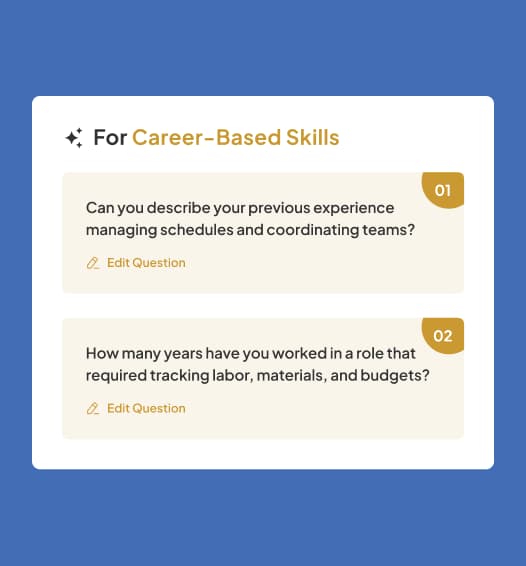
One skill set. Career, Role, Culture — chosen from the S9 45 Performance-Based Skills™ framework, locked before the first interview. Structured doesn’t mean rigid. It means nobody’s guessing what “good” looks like anymore.
How a structure gets built
Read the role. Not between the lines. Every job description drops clues about what success actually looks like. S9 reads it first — before any human does.
Start from the job description.Not answers handed down from on high.
The hiring manager uploads their JD or creates one live. The S9 Performance Framework reveals the skills critical to success across Career, Role, and Culture — a starting point, not an answer handed down from on high.
Review and edit the skill set.Every suggestion can be challenged.
AI proposes. Humans have trust issues. Good — every suggested skill can be challenged, removed, added, or rewritten. Typically lands around ten Role skills and five Culture skills, on top of the Career hard skills.
Finalize & lock it in as the standard.No editing per interview or interviewer.
Once finalized, it’s fixed — no editing per interview, no editing per interviewer. What’s being measured can’t quietly drift halfway through hiring for the role.
Every interviewer works from the same foundation.Consistency isn’t left to memory.
Same structure, whoever’s asking, whichever candidate. Consistency isn’t a rule interviewers are trusted to remember — it’s just what they’re handed.
Three categories, one skill pool
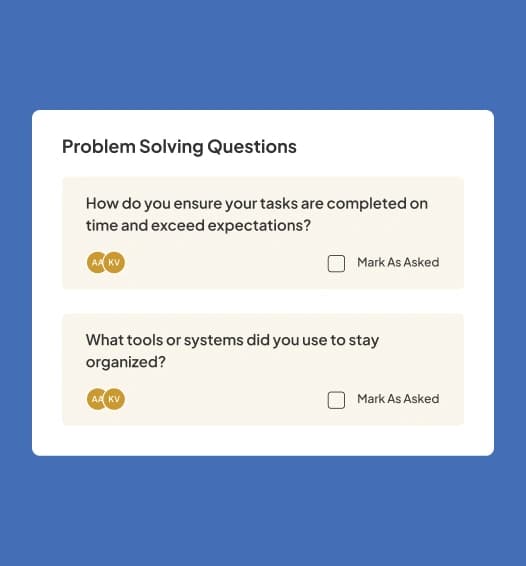
Hiring a Sales Director isn’t hiring a Software Engineer. Measuring them the same way would be lazy. That’s why every framework draws from three categories inside the S9 45 Performance-Based Skills™ pool:
The hiring manager picks which of the 45 apply here. Nothing’s assigned by default — the role decides the mix, not a formula.
Structured, not rigid
Robots don’t need to interview robots. This isn’t reading questions off a card. It’s agreeing on what matters before anyone opens their mouth.
A fixed skill set isn’t a fixed script.
What’s locked is what gets measured — not the words used to measure it.
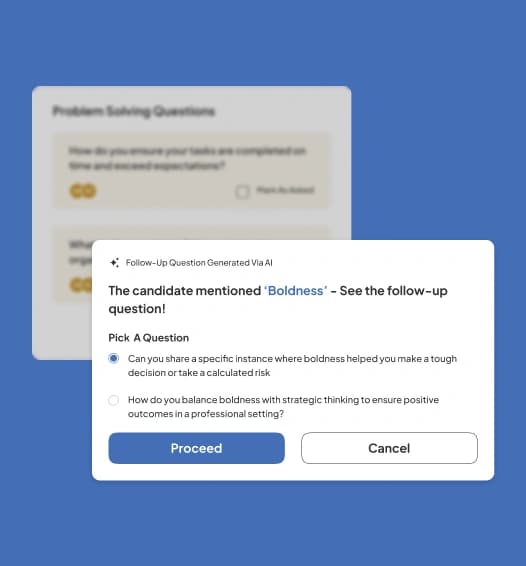
The S9 AI Interview Assistant still generates follow-ups based on how each candidate actually answers, and interviewers adapt phrasing and pacing as they go.
Same standard for every candidate. Not the same conversation, word for word.
Agreeing on what matters
Before anyone opens their mouthWhat’s locked
What’s not locked
Same standard, different conversation
Who does what
Recruiter
Builds the first draft, coordinates it toward locked. One-and-done per role, not a per-candidate chore.
Hiring Manager
Brings the context AI doesn’t have. Challenges the suggestions. Confirms what “good” actually means here, before it’s locked.
Interviewer
Doesn’t decide what to measure, just gets on with measuring it. Same skill set, same starting questions, no matter who built it or when.
Why this matters for HR leaders
Six months from now, could you explain this hire?
Candidate A got the offer over Candidate B. Ask five interviewers why, and you might get five different answers — not because anyone’s wrong, just because nobody agreed on what mattered in the first place.
S9 InnerView fixes the “why” before it becomes a problem. The skill set is locked before interviews start, so there’s one clear answer to point back to — not four people’s memory of what the role needed.
Full scoring methodology lives in Behavioral Assessments (/behavioral-assessments) and Our Science (/our-science).
Candidate A got the offer
Over Candidate BAsk five interviewers why
Skill set locked before interviews start
Before it becomes a problemOne clear answer to point back to
Frequently asked questions
Yes. It’s a strong first draft, not a verdict. Hiring manager and recruiter decide what stays, what goes, what matters most.
No. You pick what applies to this role from the pool — Career, Role, and Culture — nothing’s forced on by default.
Recruiter, hiring manager, or both — usually both, actually. Whoever finalizes it, every interviewer inherits it.
Yes. That’s not a bug, it’s the entire feature.
The candidate interviews once. Your team shouldn’t run five different interviews for it.
Build the standard once. Every interviewer inherits it. Every decision comes with a reason attached.
Still here? Respect.
You've read more than most interviewers read job descriptions.
Take five, here's something to listen to that isn't a cue card.